

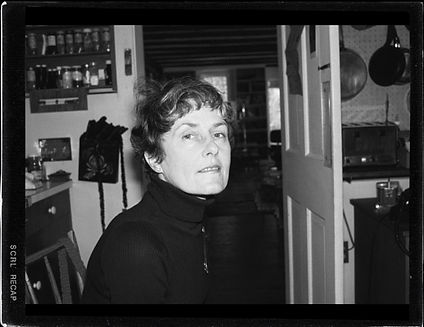
There are photographers who capture the world.
And then there are photographers who quietly speak to it.
Inge Morath belonged to the second category.
Her photographs do not interrupt.
They observe.Softly.Patiently.Almost politely.As if the world had briefly agreed to lower its voice in her presence.There is something strangely intimate about Morath’s work.Not intimate in an invasive sense.Not the kind of intimacy demanding explanation.More in a way that suggests trust.A quiet understanding between the photographer and the photographed.As though people momentarily forgot they were being seen.And perhaps that is what makes her work feel so particular — the absence of force.No excessive dramatization.No insistence.No visual performance desperately asking for importance.Just observation.And somehow — that becomes enough.Morath travelled relentlessly.Photographing people, cities, silences, contradictions.Yet what remains most remarkable is not only what she saw — but how.Because photography has never simply been documentation.It is perspective.Interpretation.A negotiation between reality and the person standing behind the lens.Which means every photographer quietly reveals themselves through what they choose to notice.And Inge Morath noticed gently.She photographed the world not as spectacle,but as conversation.A side of reality that perhaps only she could have witnessed in quite that way.The world according to Inge Morath felt quieter.Slower.More observant.And maybe that is precisely why her work continues speaking —because it never felt the need to raise its voice.

© Inge Morath | Magnum Photos
There is something deeply interesting about Inge Morath’s identity as a photographer because she never felt intrusive.
And photography, quite frankly, often is.
Born in Austria in 1923, Morath entered photography almost accidentally after working as a translator and journalist. Which perhaps explains something important about her images — she approached the world almost linguistically.
Like somebody trying to understand rather than simply document.
She joined Magnum Photos in the 1950s, becoming one of the first women within a photographic environment overwhelmingly dominated by men.
Yet Morath never seemed interested in proving herself loudly.
No aggressive visual statements.
No desperate need to impose authority.
Just observation.
Careful, intelligent observation.
Almost as if she understood that seeing quietly is still a form of power.


© Inge Morath | Magnum Photos

Inge Morath photographed the world softly.
Which sounds simple.
But perhaps isn’t.
Her visual language existed somewhere between documentary realism and quiet surrealism.
Ordinary moments suddenly felt slightly strange.
Beautiful accidentally.
Human without trying too hard.
Her photographs rarely feel staged, even when they technically are.
There is movement.
Imperfection.
Silence.
People appearing almost unaware of themselves.
She was deeply interested in environments, gestures, faces, emotional pauses — the small psychological details most people overlook.
Morath did not photograph spectacle.
She photographed atmosphere.
And perhaps that is why her work feels timeless.
It never screams.
It simply stays with you.
© Inge Morath | Magnum Photos

Some photographers photograph reality.
Inge Morath photographed her reality.
Or perhaps more accurately — the reality she quietly discovered while everyone else was distracted.
One of her most iconic works, A Llama in Times Square, almost feels absurd at first glance.
A llama.
New York City.
Complete visual contradiction.
Yet somehow — perfectly natural.
That strange ability to make surreal moments feel emotionally believable became one of Morath’s quiet strengths.
Her portraits of artists, writers and cultural figures such as Arthur Miller, Alberto Giacometti and Pablo Picasso also reveal something significant about her approach.
People rarely appear performative.
Famous perhaps.
But still human.
Still slightly vulnerable.
Still existing somewhere beneath image-making.
And perhaps this is what made Morath exceptional —
she photographed people as if she was listening to them.
© Inge Morath | Magnum Photos

If Inge Morath was trying to say anything through her photographs, perhaps it was this:
look closer.
The world reveals itself quietly.
Her work was never loud.
Never dramatic.
Never desperately searching for significance.
And somehow — that became the significance.
Morath reminds us that beauty rarely exists in performance.
It exists in pauses.
In ordinary gestures.
In moments most people would walk past without noticing.
The world according to Inge Morath felt slower.
Gentler.
As if life itself had briefly lowered its voice enough for someone to actually pay attention.